


2018-11-21


Note: This content was written prior to BrainStory, the brand that followed Slide Lab.
In this blog post, we want to help you define your brand’s style with storytelling techniques.
Defining the style (or character) of a brand is one of the most complicated tasks when creating a new brand or considering rebranding.
The style with which we define our brand will be what will differentiate us from the competition. It will grant significance to the brand among our clients, potential clients and the general public.
In this article, we will explain to you how you can define the style of your brand using storytelling techniques.
As explained to us by Wikipedia, Carl Jung, born in Switzerland in 1975, was “a psychiatrist and psychotherapist (...) who founded analytical psychology. Jung proposed and developed the concepts of extroverted and introverted personality, of the archetype and of the collective unconscious.”
Jung studied the collective unconscious and understood that humanity has similar imagination instincts. Carl Jung understood that, generally speaking, people identify with certain archetypes (as he called them). The archetypes are no more than stock characters that have characteristics that any person in the world understands spontaneously.
This is the theory that allows us to understand why stories like Star Wars or Harry Potter are so well received all over the world. All the characters in these stories fit into one of the archetypes that Jung described. Thus, even without being fully aware of it, we fit the characters into these archetypes whenever we tell a story.
However, the important thing here is to understand how these archetypes can help us define our brand. In other words, how storytelling techniques can help us define the unique style and voice of our brand, and, in this way, reach the collective unconscious of any potential customer in the world.
The idea is simple, but it requires some time and dedication.
Follow the steps below to create your brand’s style with storytelling techniques:
1 – List of archetypes
Be familiarised with all Jungian archetypes (which we will describe further).
2 – Conscious choice
Choose the archetype that best identifies with the characteristics that we want our brand to have and convey.
(Take one of Jung's personality tests on the Internet, filling out all the fields with your brand’s information. Here is an example: https://www.psychologistworld.com/tests/jung-archetype-quiz)
3 – Personality definition
Define two or three of your brand's personality traits (based on the description of the archetype – the character that our brand is “incarnating”).
4 – Tone definition
Describe the tone of your brand's voice, thinking of it as a character in a story.
5 – Story writing
Imagine your brand is the character of a small tale and explore it. What would it do in a certain situation? How would it behave? What kind of attitude would it have when facing a problem? How would it introduce itself to friends at a party?
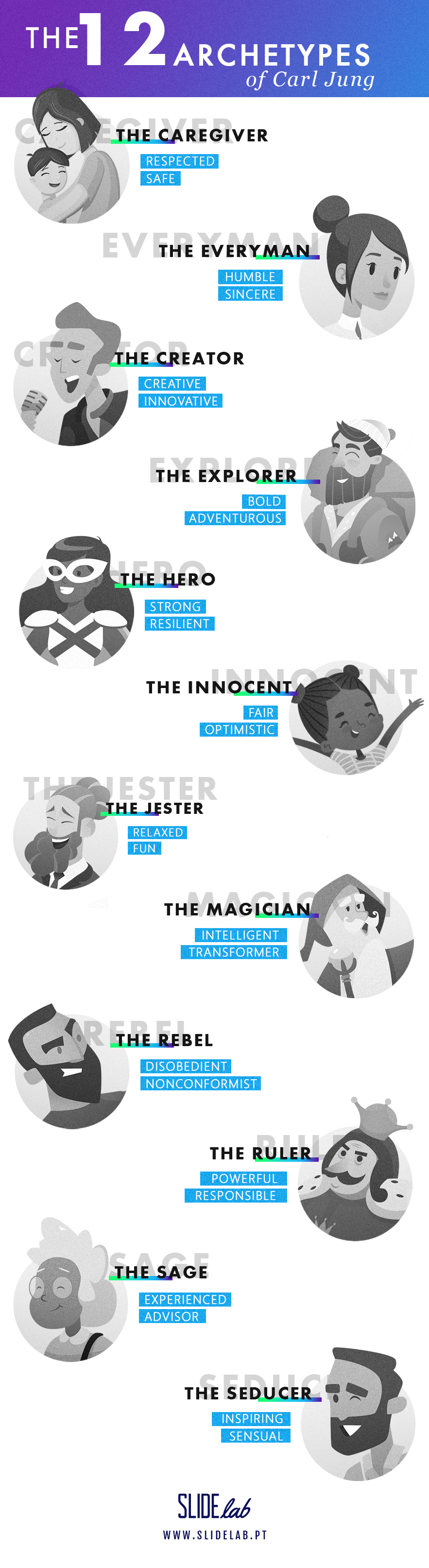
The Caregiver
They have a great desire to help others as they would help themselves.
Essentially associated with brands related to education, health and non-profit causes.
The Everyman
They believe all people are equal, don’t like to be left out, but doesn’t strive to stand out from the rest either.
Perfect for brands promoting everyday affordable products.
The Creator
They use their imagination to create something that did not exist before, therefore being an agent of change.
Associated with brands that help people be creative and produce more.
The Explorer
They dig up new concepts or objects, or challenge others to find something new or to perform innovative actions.
Associated with brands that encourage people to be free or express their individuality.
The Hero
Heroes are generally strong, but they manage to control their strength for the benefit of others.
They can be associated to almost every brand and company. However, they’re most suitable for moderate to high-priced products with an innovative profile and potential to impact the world.
The Innocent
Optimistic by nature, they smile even under difficult circumstances.
Associated with products that offer a simple solution to an easily identifiable problem. Innocents let the child within us loose.
The Jester
Usually, it's the jester who tells the truth no one wants to hear or dares to say. This archetype relieves the tension in situations.
Associated with brands that help people have fun and feel part of a group.
The Magician
This character generates transformation, and often surpasses the impossible, using methods that are not accessible to the common mortal.
Recommended for brands that catalyse change and positively influence people.
The Rebel
Rebels defy the status quo through disobedience and inconformity. This archetype likes to be seen as bad, whether just a little or completely, and sometimes likes to generate fear in others.
Associated with brands that do not follow current social standards and want to create out-of-the-box things.
The Ruler
These characters often define the rules, and they are always powerful. However, they can be good or bad.
Recommended for luxury brands that make consumers feel powerful.
The Sage
The sage is the embodiment of wisdom, and offers intellectual solutions to problems while staying away from confusion.
Associated with brands that inform and stimulate consumer thinking.
The Seducer
They get pleasure from their senses, or make other characters discover their own sensual abilities.
Recommended for brands that stimulate beauty and sensuality.
After going through these five steps, you will understand that you can now create, in an easier way, a style book for your brand, aligning the tone and the purpose of all your communication messages, so that they’re more easily understood and accepted by your consumers.
The use of storytelling techniques isn't limited to creating presentations, and should be used in various dimensions of our personal and professional lives.
References:

